
 AI Tools
 Health
 Math
Math Everyday Life
 Finance
 Physics
 Chemistry
 Statistics
 Construction
 Pets
Pets Time & Date
 Conversion Calculator
 Sign In
Follow Us On:
Follow Us On:
Make conversions between rectangular (Cartesian) and polar plane coordinates.
Related
This calculator is used to convert rectangular to polar coordinates and vice versa for a 2D system. It shows the step-by-step calculation for both conversions.
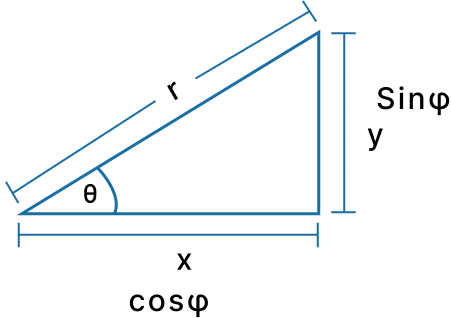
Polar coordinates represent a point that is positioned with respect to the origin (0,0) and an angle from the origin in the reference direction. They are written as (r, θ), such that:
Cartesian coordinates indicate a point in an XY-plane by a pair of numerical values. These coordinates are signed distances from a point to two perpendicular directed lines. They are usually written as (x, y), such that:
There are two methods of converting between the coordinates:
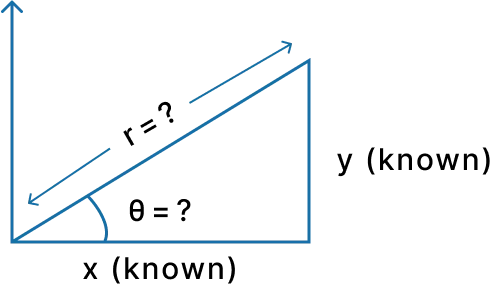
For rectangular coordinates (x, y) given in the above picture, you can find polar coordinates (r, θ) as follows:
r = √(x² + y²)
θ = arctan(y / x)
Use the following polar equations to cartesian equations for converting:
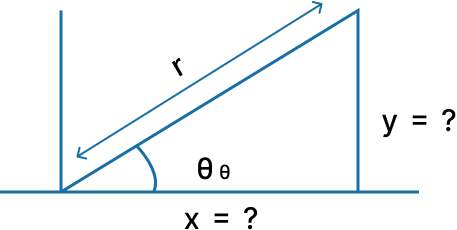
 to polar coordinates example.webp)
Solution:
Data Given:
Calculations:
Step 1: Determine ‘r’
r = √(x² + y²)
r = √(6² + 2²)
r = √(36 + 4)
r = √(40)
r = 6.324555320336759
Step 2: Determine ‘θ’
θ = arctan (y/x
θ = arctan (2/6
θ = arctan (1/3
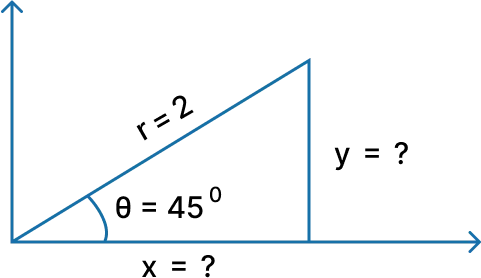
Solution:
Data Given:
Calculations:
Step 1: Determine Horizontal Rectangular Component ‘x’
x = r cos θ
x = 2 ∗ 0.707
x = 1.414
Step 2: Determine Vertical Rectangular Component ‘y’
y = r sin θ
y = 2 * sin(45°)
| Cartesian (x, y) | Polar (r, θ) |
|---|---|
| (3, 4) | 5, arctan(4/3) ≈ 53.13° |
| (-2, 1) | √5, arctan(1 / -2) ≈ -26.57° |
| (0, 5) | 5, 90° |
| (-4, 4) | √32, arctan(4 / -4) ≈ 135° |
This polar coordinates calculator can handle all the conversions between coordinates including all ones listed in the above table, with the complete solution shown.
No, the polar coordinates of a point are not unique. The reason is that each point can be represented by infinite polar coordinates in infinite ways.
In polar coordinates, z represents the complex number in polar form, such that: z = x + iy (where i (iota) = √-1
Where
The polar coordinate representation of 1 is given as:
1 = 1 e^(i 0)
The same equation holds true for 1 e^(i 2π) due to the fact that sine and cosine are both periodic with the angle 2π.
Related
Add this calculator to your site.
×Just copy a given code & paste it right now into your website HTML (source) for suitable page.
Preview:



Easter into Action, Save With Satisfaction
UPTO
50 %
OFF
Give Us Your Feedback
Share Result
Polar Coordinates Calculator

Links
Home Conversion Calculator About Calculator Online Blog Hire Us Knowledge Base Sitemap Sitemap TwoEmail us at
Contact Us© Copyrights 2026 by Calculator-Online.net
How was your experience today?
Not now
Awesome! Would you mind sharing that on Trustpilot?
Your review helps others find a tool that actually works.
Write a Review on TrustpilotNot now
Sorry to hear that
Tell us what went wrong — we read every message.
Not now
Thanks for your feedback!
We'll use it to make things better.
